
Legal and Advocacy
Psilocybin Legality by State in 2026: The Complete Updated Guide
Mar
Introduction
Psilocybin legality by state in 2026 has never been more complex — or more rapidly changing. What was a straightforward Schedule I prohibition across all 50 states just six years ago has fractured into a patchwork of full legalization, supervised therapeutic access, city-level decriminalization, research authorization, and strict prohibition — with new legislation advancing in over a dozen states simultaneously.
Understanding where psilocybin stands legally in your state is not just a matter of academic interest. It has real implications for your safety, your rights, and your access to one of the most promising therapeutic tools in modern psychiatry. This guide gives you the most accurate, current picture of psilocybin legal status across the United States as of March 2026 — organized clearly, with honest explanations of what each legal category actually means in practice.
Before diving in: this article is for educational purposes only and does not constitute legal advice. Laws change rapidly in this space. Always verify current legal status in your specific jurisdiction — and for a full understanding of how psychedelic therapy is structured and accessed in states where it’s legal, see our Psychedelic Therapy Cost & Access in 2026 guide.
Understanding the Legal Categories: What They Actually Mean
Before breaking down psilocybin legality by state, it’s critical to understand that the language used — “legal,” “decriminalized,” “research authorized” — describes very different legal realities that are frequently conflated in media coverage.
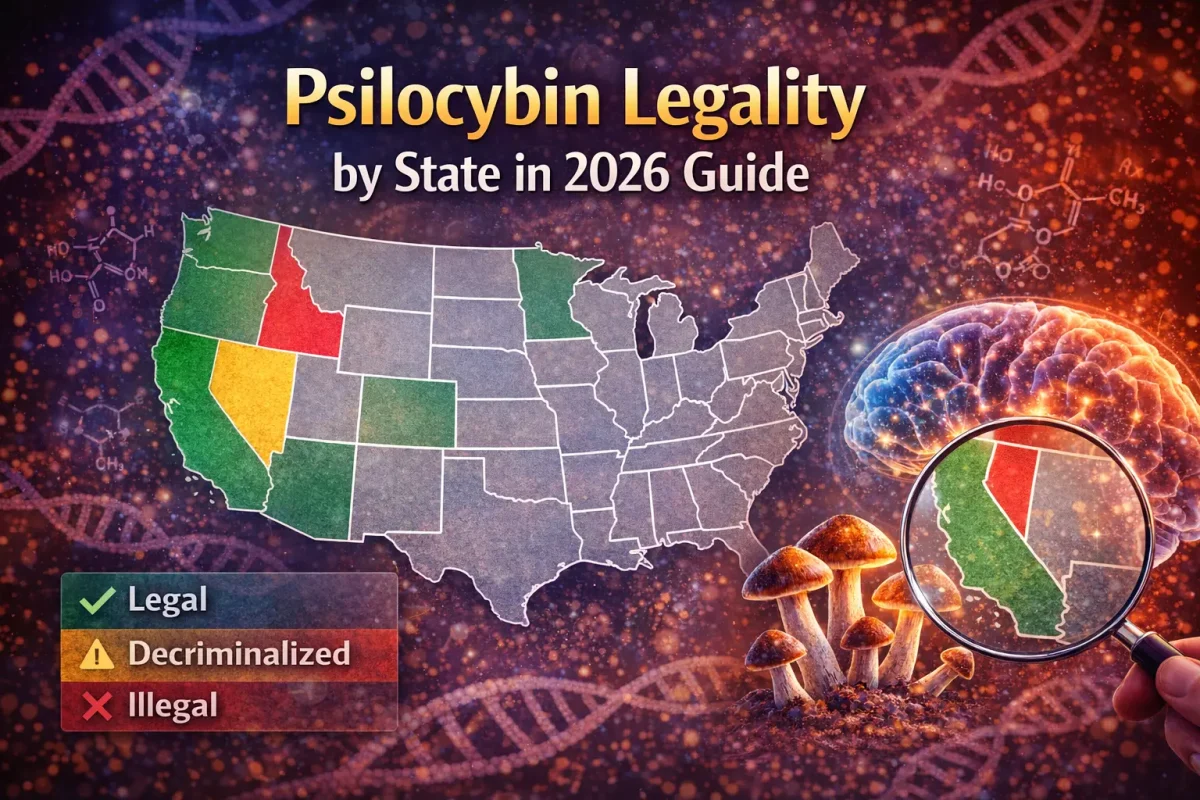
✅ Legal / Therapeutic Access Psilocybin can be legally produced, dispensed, and consumed in a regulated framework. In Oregon and Colorado, this means licensed service centers where adults 21+ can access supervised psilocybin sessions. Personal possession in small amounts is also permitted. Commercial sale outside licensed frameworks remains prohibited.
🟡 Decriminalized Psilocybin remains technically illegal, but criminal penalties for personal possession have been eliminated or significantly reduced. Law enforcement has been directed to make psilocybin arrests the lowest priority. There is no legal market — you cannot buy or sell psilocybin legally. Getting caught with it will not result in criminal prosecution in most cases, but it does not protect you from federal law.
🔵 Research Authorized State legislation has created pathways for clinical research institutions to study psilocybin under state supervision. This does not create access for the general public — only for approved research participants through registered clinical trials.
⚫ Illegal Possession, cultivation, and distribution of psilocybin are criminal offenses under state law, mirroring the federal Schedule I classification. Penalties vary widely — from misdemeanor possession charges to felony manufacturing and distribution.
🔗 Authority Source: Psychedelic Drug Legislative Reform and Legalization in the US — JAMA Psychiatry, PMC
✅ States Where Psilocybin Is Legal: Full Therapeutic Access
Oregon — Legal Since 2023
Oregon made history in November 2020 when voters passed Ballot Measure 109, creating the first state-regulated supervised psilocybin therapy program in the United States. Licensed service centers began operating in 2023 following the development of the regulatory framework by the Oregon Health Authority.
What’s legal in Oregon:
- Adults 21+ may access psilocybin sessions at licensed service centers statewide
- No prescription or mental health diagnosis required
- Licensed facilitators supervise all dosing sessions
- Psilocybin is available in licensed service centers in Benton, Columbia, Deschutes, Hood River, Jackson, Lane, Lincoln, Multnomah, Wasco, Washington, and Yamhill counties
- Personal possession of small amounts is decriminalized
What’s not legal:
- Home use or personal possession purchased outside licensed centers
- Commercial sale outside the licensed service center framework
- Note: Oregon’s statewide drug decriminalization measure (Measure 110) was repealed by the legislature in 2024 — but Measure 109’s psilocybin therapy framework remains fully in effect
Cost: A full psilocybin treatment plan in Oregon typically costs $3,500–$5,000. For the full breakdown, see our Psychedelic Therapy Cost & Access guide.
Colorado — Legal Since Late 2025
Colorado’s Proposition 122 (the Natural Medicine Health Act) passed in November 2022 and created the broadest regulated psychedelic framework in the United States. Licensed healing centers began legally providing psilocybin therapy in late 2025, with the program expanding rapidly through 2026.
What’s legal in Colorado:
- Adults 21+ may access psilocybin services at licensed healing centers
- Personal possession, home cultivation, and sharing (without sale) of psilocybin are legal for adults 21+
- Colorado’s framework also covers psilocin, DMT, ibogaine, and mescaline — with regulated healing center access for these compounds expanding through 2026
- Psilocybin therapy can be integrated with other licensed mental health services, including psychotherapy delivered at the same clinic
What’s not legal:
- Commercial sale of psilocybin outside licensed healing centers
- Public consumption
New Mexico — Limited Exception
New Mexico occupies a unique legal position based on a 2005 Court of Appeals ruling (State v. Tatum) that determined the personal cultivation and ingestion of psilocybin mushrooms does not constitute “manufacturing” a controlled substance under state law. This creates a limited personal cultivation exception — but psilocybin remains a controlled substance in New Mexico, meaning sale and distribution are still illegal. Regulated psilocybin therapy programs are expected to begin by December 2026, with the rules and regulations currently being finalized.
🟡 Cities & Jurisdictions Where Psilocybin Is Decriminalized
Decriminalization at the city or county level does not change state or federal law — but it means local law enforcement will not arrest or prosecute adults for personal psilocybin possession or use. Here is the current landscape of decriminalized jurisdictions as of March 2026:
California:
- Oakland (2019) — personal possession and use deprioritized
- Santa Cruz (2020) — personal possession and cultivation decriminalized
- Arcata — enforcement deprioritized
Colorado:
- Denver (2019) — the first US city to decriminalize psilocybin; enforcement deprioritized for adults 21+
Washington:
- Seattle — personal possession deprioritized
- Port Townsend — enforcement deprioritized
Michigan:
- Ann Arbor — personal possession decriminalized
- Detroit — enforcement deprioritized
- Hazel Park — enforcement deprioritized
Massachusetts:
- Somerville — personal use and possession deprioritized
- Cambridge — deprioritized
- Easthampton — deprioritized
- Northampton — deprioritized
Washington, DC:
- Initiative 81 (passed November 2020, effective March 2021) — entheogenic plants and fungi including psilocybin mushrooms made the lowest law enforcement priority; personal possession and use decriminalized
Important caveat: Decriminalization is local. Even in decriminalized cities, psilocybin remains illegal under state and federal law. The protection is from local prosecution only — federal authorities retain full legal authority to prosecute.
🔗 Authority Source: Psychedelics Legalization & Decriminalization Tracker — Psychedelic Alpha
🔵 States With Active Research Authorization or Legislation in Progress
This is the fastest-moving category in 2026 — states that have not yet legalized or decriminalized psilocybin but have created formal research pathways or have active legislation advancing through their legislatures.
States With Active Research Programs or Task Forces
Texas: Passed HB 1802 authorizing psilocybin-assisted therapy research for veterans’ PTSD, funded by $50 million from the state legislature. A significant and bipartisan signal of political will — the strongest psychedelic research commitment from a traditionally conservative state.
Washington State: Established a formal psilocybin work group to study the drug and recommend regulatory frameworks. State-level penalties for personal possession of Schedule I substances were also reduced in 2021.
Alaska: House Bill 228, establishing an Alaska task force for the regulation of psychedelic medicines potentially approved by the FDA, became law in 2024. Activists have filed the Alaska Natural Medicine Act — an initiative targeting the 2026 ballot — which would decriminalize and regulate psilocybin, DMT, and mescaline.
Connecticut: Multiple bills advancing in 2025–2026 legislative sessions, including HB 5456 (modeled after New York’s framework) which would allow trained state-approved facilitators to offer psilocybin-assisted therapy to qualified patients.
Indiana: HB 1166 allocates up to $600,000 over 2025–2026 to fund an existing psilocybin research program. SB 139 established a therapeutic psilocybin research fund administered by the Indiana Department of Health.
Minnesota: Active legislation proposed establishing psychedelic-assisted therapy research frameworks for mental health treatment.
States With Legislation Filed or Under Consideration
The following states had active psilocybin-related legislation filed or under committee review as of early 2026. Status may have changed — verify with your state legislature’s official tracking system:
- Alaska — Natural Medicine Act ballot initiative targeting 2026
- Georgia — Legislation under review
- Illinois — Bills filed for decriminalization and research
- Iowa — Research authorization bills
- Kansas — Bills filed
- Kentucky — Research legislation advancing
- Maine — Decriminalization bills
- Massachusetts — HB 1494 (statewide decriminalization and research legalization)
- New Hampshire — Legislation under consideration
- New York — Multiple bills including SB 495 (facilitator-assisted therapy program for veterans and first responders) and SB A8569A (state-funded medical psilocybin treatment program)
- Rhode Island — HB 7715 (decriminalization and medical prescription pathway)
- Vermont — Research and decriminalization bills
⚫ States Where Psilocybin Remains Fully Illegal
In the majority of US states, psilocybin retains its full Schedule I controlled substance status. Possession, cultivation, sale, and distribution are criminal offenses with penalties that vary significantly by state.
States with particularly severe penalties include:
- Florida: Psilocybin possession is a felony in Florida. Notably, Florida also specifically prohibits the sale and possession of psilocybin mushroom spores as of 2025 — closing the spore loophole that exists in most other states.
- Georgia: Possession can result in felony charges; spore sales also explicitly prohibited.
- Idaho: One of the strictest states — psilocybin mushroom spores themselves are explicitly prohibited in Idaho, meaning even research-oriented possession carries legal risk.
- California: Despite city-level decriminalization in Oakland, Santa Cruz, and Arcata, psilocybin remains a Schedule I controlled substance at the state level. Statewide legalization bills have failed to advance in recent legislative sessions.
States where enforcement is stricter and penalties higher: Alabama, Arkansas, Louisiana, Mississippi, Missouri, Nebraska, North Dakota, Oklahoma, South Carolina, South Dakota, Utah, West Virginia, Wyoming — all maintain full Schedule I classification with limited to no legislative movement toward reform.
Federal Law: The Override That Never Goes Away
No discussion of psilocybin legality by state is complete without addressing the federal layer — because federal law supersedes all state law, and psilocybin’s federal status has not changed.
Psilocybin remains a Schedule I controlled substance under the federal Controlled Substances Act — classified as having high abuse potential, no accepted medical use, and a lack of accepted safety for use under medical supervision. This federal classification means:
- Federal law enforcement agencies (DEA, FBI) retain authority to prosecute psilocybin offenses regardless of state law
- Interstate transport of psilocybin is a federal crime regardless of the legality in the origin or destination state
- Federal employees and those with federal security clearances face specific risks even in states where psilocybin is state-legal
- Military personnel are subject to federal law regardless of their state of residence
The pathway to changing psilocybin’s federal status runs through FDA approval. Compass Therapeutics’ COMP360 is furthest along — with a Phase III confirmatory trial readout expected H2 2026. If approved, psilocybin would likely be rescheduled to Schedule IV, opening the door to prescriptions and eventually insurance coverage. For context on that timeline, see our Psychedelic Therapy Cost & Access guide.
For veterans specifically, the 2024 National Defense Authorization Act created pathways for active-duty service members to participate in clinical trials involving psilocybin — a significant federal acknowledgment of its therapeutic potential. See our Psilocybin for PTSD Veterans guide for full details.
Psilocybin Spores: The Legal Grey Zone
A frequently misunderstood aspect of psilocybin legality by state relates to mushroom spores. Because spores do not contain psilocybin or psilocin until germination, federal law does not explicitly classify them as controlled substances — creating a legal grey area exploited by a significant underground market.
States where spores are explicitly prohibited (in addition to psilocybin):
- California
- Georgia
- Idaho
- Florida (as of 2025)
In all other states: Spores technically exist in a legal grey zone — they are not federally scheduled, but possessing them with intent to cultivate psilocybin mushrooms can be prosecuted as drug manufacturing conspiracy. This is not a safe legal harbour. Possession of spores alongside cultivation equipment significantly increases prosecution risk in any jurisdiction.
Global Context: Psilocybin Legality Around the World
For readers considering international travel for psychedelic therapy, the global landscape is also evolving rapidly:
Fully legal / unscheduled:
- Jamaica — psilocybin mushrooms not scheduled; retreat industry operates legally
- Netherlands — psilocybin truffles (sclerotia) legal; mushrooms prohibited
- Brazil — psilocybin unscheduled; mushrooms not illegal
- Samoa — psilocybin mushrooms legal
Medical/therapeutic access:
- Australia — psilocybin approved for prescription use for treatment-resistant depression (since February 2023)
- Canada — psilocybin available through Special Access Program for terminal/serious illness
- Germany — regulatory pathway for approved clinical use
- New Zealand — approved for therapeutic use in specific clinical contexts
- Switzerland — available through compassionate use programs
- Czech Republic — therapeutic access pathways
Decriminalized:
- Portugal — personal possession of all drugs decriminalized (though sale/cultivation still illegal)
- Spain — personal possession and private cultivation tolerated
For anyone considering international retreat access, our Harm Reduction Guide is essential reading before traveling for any psychedelic experience.
What This Means for You: A Practical Summary
Whether you’re a patient exploring therapeutic options, a researcher tracking policy, or someone simply trying to understand the legal landscape in your state, here is the most important practical summary from this psilocybin legality guide:
If you’re in Oregon or Colorado: You have the most access — adults 21+ can access supervised psilocybin therapy at licensed centers without a prescription. Personal possession is also protected.
If you’re in a decriminalized city: Personal possession and use are deprioritized by local law enforcement, but you are not protected from state or federal law. There is no legal purchase pathway.
If you’re in a research-active state: You may be eligible for clinical trials at no cost. Search ClinicalTrials.gov for active trials in your area. This is the most medically rigorous access option outside of Oregon and Colorado.
If you’re in a fully prohibited state: The risk is real — possession is a criminal offense and penalties vary significantly by state. The only legal access pathways are: traveling to Oregon or Colorado, qualifying for a clinical trial, or traveling internationally to a jurisdiction where psilocybin therapy is legal.
The landscape of psilocybin legal status is changing faster than any other area of US drug policy — driven by clinical evidence, veteran advocacy, bipartisan political support, and a growing public understanding of psychedelic medicine’s therapeutic potential. This guide will be updated every 90 days to reflect new developments. For the science behind why this legal shift is happening, see our Psilocybin Brain Research article.
Frequently Asked Questions (FAQ)
Q: What is the psilocybin legality by state in 2026 in simple terms? Psilocybin is fully legal for supervised therapeutic use in Oregon and Colorado. It is decriminalized in over 20 cities including Denver, Oakland, Seattle, and Washington DC. New Mexico has a limited personal cultivation exception. Research programs are active in Texas, Washington State, Alaska, Indiana, and others. Everywhere else, psilocybin is a Schedule I controlled substance under state and federal law.
Q: Is psilocybin federally legal? No. Psilocybin remains Schedule I under the federal Controlled Substances Act regardless of state laws. Federal agencies retain authority to prosecute psilocybin offenses even in Oregon and Colorado. The pathway to federal rescheduling runs through FDA approval — most likely triggered by Compass Therapeutics’ COMP360 Phase III data expected H2 2026.
Q: Can I travel from my state to Oregon or Colorado to access psilocybin therapy legally? Yes — Oregon and Colorado do not restrict service access to in-state residents. Adults 21+ from any state can legally access licensed psilocybin services in both states. However, transporting psilocybin across state lines is a federal crime — you cannot bring any products home with you.
Q: Are psilocybin mushroom spores legal? Spores are not explicitly scheduled under federal law because they contain no psilocybin before germination. However, several states (California, Georgia, Idaho, Florida) explicitly prohibit spore possession. In other states, spores exist in a legal grey zone — possessing them alongside cultivation equipment significantly increases prosecution risk.
Q: How often does psilocybin legal status change? Very frequently in the current environment — new bills are filed in legislative sessions across dozens of states every year, and city-level decriminalization resolutions can pass with relatively little public notice. Always verify the most current status directly with your state legislature’s official bill tracking system or a licensed attorney in your jurisdiction.
⚠️ Legal Disclaimer: This article is for educational purposes only and does not constitute legal advice. Psilocybin laws change rapidly and vary significantly by jurisdiction. The information in this article reflects our best understanding of the legal landscape as of March 2026 and may not reflect subsequent legislative changes. Always consult a licensed attorney in your jurisdiction and verify current legal status with official state and local government sources before making any decisions related to psilocybin.
→ Read Next on The Shroom Sage:
- Psychedelic Therapy in 2026: What It Costs & How to Access It
- The Science Behind Psilocybin & the Brain: What 2026 Research Says
- Psilocybin for PTSD: What Veterans Research Shows in 2026
- How to Start Microdosing: A 30-Day Beginner Plan
