

Science and Reserach
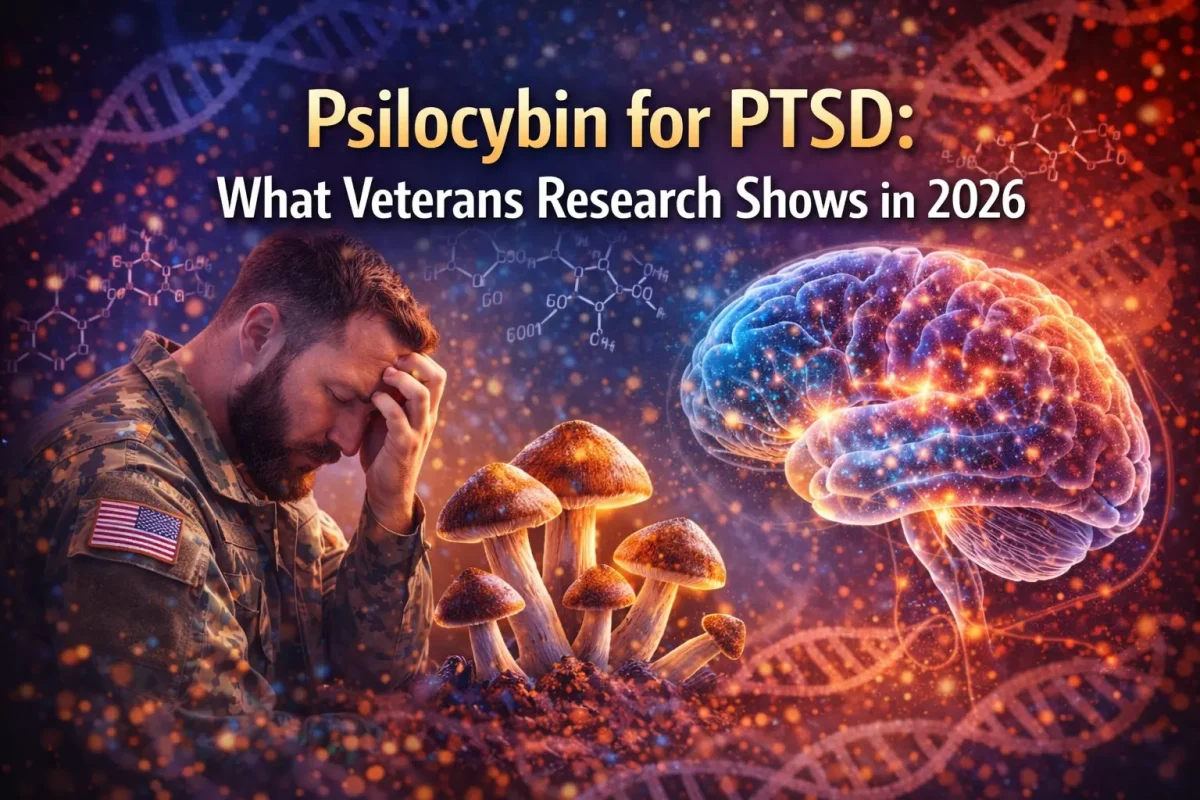
Psilocybin for PTSD: What Veterans Research Shows in 2026
Mar
Introduction
Psilocybin for PTSD veterans is one of the fastest-moving and most consequential research stories in psychiatry today — driven not just by scientists, but by the veterans themselves. The VA reports that the veteran suicide rate is 57.3% higher than the civilian rate, with 18 to 44 veterans dying by suicide every single day. That is a toll that far exceeds combat casualties. And for decades, conventional treatments — cognitive processing therapy, SSRIs, prolonged exposure — have simply not been enough for a large proportion of those affected.
That reality has catalyzed a remarkable convergence: combat veterans advocating loudly and publicly for psychedelic-assisted therapy, bipartisan congressional support, and the Department of Veterans Affairs making its first investment in psychedelic research in more than 50 years. Psilocybin for PTSD veterans is no longer a fringe conversation. It is active federal policy, live clinical trials, and the subject of growing peer-reviewed evidence.
This guide covers exactly where the science stands in 2026 — what psilocybin does to trauma circuits in the brain, what the clinical trials are showing, what the VA is doing about it, and what access pathways currently exist for veterans seeking this treatment. For the foundational neuroscience behind how psilocybin acts in the brain, see our in-depth article: The Science Behind Psilocybin & the Brain: What 2026 Research Actually Says.
The Scale of the Veterans PTSD Crisis
Before diving into the research, it’s important to understand the scale of the problem psilocybin for PTSD veterans is being asked to address.
An estimated 11–20% of veterans who served in Operations Iraqi Freedom and Enduring Freedom have PTSD in a given year. Among Vietnam veterans, that figure reaches approximately 30%. PTSD among veterans is linked to significantly elevated rates of substance use disorders, chronic pain, unemployment, homelessness, relationship breakdown, and suicide. The VA itself has acknowledged that even its best evidence-based treatments leave a substantial proportion of veterans with insufficient relief.
This treatment gap is what has made veterans among the most powerful and credible voices in the psychedelic therapy reform movement — and what has pushed psilocybin for PTSD veterans from academic curiosity to urgent policy priority.
How Psilocybin Targets Trauma Circuits in the Brain
To understand why psilocybin shows such promise for PTSD specifically, you need to understand what PTSD does to the brain — and what psilocybin undoes.
PTSD is characterized by hyperactivation of the amygdala (the brain’s threat-detection center), impaired hippocampal function (which normally contextualizes fear memories), and over-engagement of the default mode network — trapping survivors in rigid loops of intrusive recall, hypervigilance, and emotional numbing.
Psilocybin for PTSD veterans works on precisely these mechanisms. As research has consistently shown, psilocybin disrupts the default mode network, reduces amygdala reactivity during emotional processing, promotes neurogenesis in the hippocampus — which may directly counteract impaired fear extinction central to PTSD — and facilitates the kind of emotional breakthrough experiences that have been identified as key mediators of lasting psychological change.
Psilocybin also appears to promote fear extinction — the process by which the brain learns that a previously threatening stimulus is no longer dangerous. This is exactly what is impaired in PTSD. The VA’s own National Center for PTSD has noted that psilocybin facilitates fear extinction and neurogenesis in animals, which may directly counteract the mechanisms that underlie PTSD’s development and maintenance.
🔗 Authority Source: Psychedelic-Assisted Therapy for PTSD — PTSD National Center for PTSD, VA
The result of all these mechanisms working together is a neurological environment that is, temporarily but significantly, more open to reprocessing traumatic memories — more amenable to the kind of perspective shift that therapists have long known is central to healing from trauma. This is why psilocybin for PTSD veterans is not simply a drug treatment — it is a neurobiological facilitator of the psychotherapeutic work that produces lasting change.
The VA’s Historic Investment in Psychedelic Research
For over 50 years, the Department of Veterans Affairs did not fund a single study on psychedelic-assisted therapy. That changed in 2024 — and 2026 has seen that commitment expand significantly.
In 2024, the VA announced funding for MDMA- and psilocybin-assisted therapy studies, marking the first time the agency directly supported psychedelic research for veteran mental health. The VA has since expanded its psychedelic-assisted therapy trials to nine VA facilities, spanning the Bronx, Los Angeles, Omaha, Palo Alto, Portland (Oregon), San Diego, San Francisco, West Haven, and White River Junction.
Each site is recruiting participants based on specific diagnostic criteria and treatment history. Some trials focus on combat-related PTSD. Others include veterans with depression or generalized anxiety disorder who have not responded to standard therapies. A separate VA-funded study, conducted in partnership with Brown University and Yale University, is evaluating MDMA-assisted therapy specifically for veterans with both PTSD and alcohol use disorder — a critical dual-diagnosis combination that conventional care consistently struggles to treat.
The VA’s stated goal: not to replace traditional care, but to determine whether psychedelic-assisted therapy can enhance recovery for patients who haven’t improved with existing options.
🔗 Authority Source: VA Funds First Study on Psychedelic-Assisted Therapy for Veterans — VA.gov
Congressional Action & the PATH Caucus
The VA’s research investment did not happen in a vacuum. It was driven in significant part by bipartisan congressional advocacy, led by the Congressional Psychedelics Advancing Therapies (PATH) Caucus, co-chaired by Representatives Lou Correa (D-CA) and Jack Bergman (R-MI).
Under the 2024 National Defense Authorization Act, the Department of Defense was required to establish a process by which service members with PTSD or traumatic brain injury could participate in clinical trials involving psilocybin, MDMA, ibogaine, and 5-MeO-DMT. The DoD was empowered with $10 million to partner with federal agencies and academic institutions for these trials.
In April 2025, Correa and Bergman introduced a bill to provide $30 million annually to establish psychedelics-focused “centers for excellence” at VA facilities, where veterans could receive novel treatment involving psilocybin, MDMA, and ibogaine. VA Secretary Doug Collins met with the PATH Caucus co-chairs and has publicly expressed willingness to pursue bold, data-driven solutions for veteran mental health.
Texas separately passed HB 1802 with overwhelming bipartisan support, funding a psilocybin-assisted therapy study for veterans’ PTSD — led by Dr. Lynnette Averill — exploring two doses of psilocybin combined with preparation and integration sessions. California passed AB 1103 to fast-track psychedelics research for PTSD and depression, with significant backing from veterans’ organizations.
The trajectory is clear: psilocybin for PTSD veterans has become one of the few bipartisan policy areas where meaningful progress is being made, driven by a veterans community that has lost patience waiting for conventional medicine to catch up.
What the Clinical Evidence Shows So Far
While the VA and DoD trials are still underway, a growing body of earlier clinical research provides meaningful signal for psilocybin’s potential in trauma treatment.
Phase 2 depression data with trauma overlap: Johns Hopkins’ published research showed psilocybin-assisted therapy producing large reductions in depression — a condition that co-occurs in approximately 50% of PTSD cases — with effects persisting at 12-month follow-up. The same neurological mechanisms that drive depression relief (DMN disruption, amygdala quieting, neuroplasticity) are directly relevant to psilocybin for PTSD veterans.
Systematic review findings: A comprehensive systematic review published in Current Treatment Options in Psychiatry in December 2025, analyzing 42 studies and 5,155 initial citations, found preliminary data for psilocybin suggesting potential benefits for PTSD. MDMA currently has the strongest PTSD evidence base — 67% of MDMA-assisted therapy participants no longer met PTSD criteria after three sessions in Phase 3 trials — but psilocybin’s overlapping mechanisms make it a strong candidate for further investigation.
Emotional breakthrough as mechanism: Research from Johns Hopkins suggests that the “emotional breakthrough” experiences facilitated by psilocybin — characterized by feelings of unity, sacredness, and profound personal significance — are themselves key mediators of lasting therapeutic change. For veterans with PTSD, whose trauma has often disrupted their sense of identity and meaning, this dimension of psilocybin for PTSD treatment may be particularly significant.
For a full picture of how to approach any psilocybin experience with appropriate preparation, our Set & Setting Guide explains the principles that clinical researchers build their protocols around. And for the complete landscape of what psilocybin has demonstrated across all conditions, see our long-term depression results analysis.
The Role of Psychotherapy: It’s Not Just the Drug
One of the most important findings from all psychedelic-assisted therapy research — including psilocybin for PTSD veterans — is that the compound alone does not produce the therapeutic outcome. The structured psychotherapy component is essential.
In all the VA and academic trials, veterans receive:
- Preparatory sessions — building trust with therapists, setting intentions, understanding what to expect
- Dosing sessions — supervised psilocybin experiences in a carefully controlled clinical environment
- Integration sessions — structured processing of insights and experiences to consolidate therapeutic gains
Dr. Rachel Yehuda, director of PTSD research at the Bronx VA, has emphasized that the therapy’s effectiveness depends on its structure, not just the compound. Psilocybin for PTSD veterans is best understood as a neurobiological facilitator that makes the brain temporarily more plastic and open — and skilled trauma-informed therapy that channels that openness toward healing.
This is why accessing psilocybin outside of a structured therapeutic context — particularly for someone with active PTSD — carries significant risk. For a comprehensive safety framework, our Harm Reduction Guide is essential reading before considering any psychedelic experience.
Access for Veterans in 2026: What’s Actually Available
For veterans seeking psilocybin-assisted therapy in 2026, the honest answer is: access remains limited but is expanding.
Within VA clinical trials: Veterans who meet specific diagnostic criteria (treatment-resistant PTSD, major depressive disorder, or co-occurring PTSD and alcohol use disorder) may be eligible to enroll in active VA trials at the nine participating facilities. Eligibility requirements vary by site and study.
Oregon and Colorado: Both states have legal frameworks for supervised psilocybin therapy. Oregon requires therapy to take place at a licensed service center with a licensed facilitator. Colorado’s framework permits regulated recreational and therapeutic use. Veterans in these states have legal access to supervised psilocybin therapy — though it remains out-of-pocket and not VA-covered.
ClinicalTrials.gov: Veterans can search for active psilocybin-related PTSD trials using keywords including “veteran,” “PTSD,” and “psilocybin” at clinicaltrials.gov, which lists all federally registered clinical research.
International access: Some veterans have traveled to treatment centers in Mexico, which does not restrict ibogaine or psilocybin, to access supervised psychedelic therapy. This remains medically risky without proper vetting of facilities and is not a route we recommend without extensive research.
For a complete legal landscape by state, see our Psilocybin Legality by State in 2026 guide.
Important Safety Considerations for Veterans with PTSD
Psilocybin for PTSD veterans carries specific safety considerations that differ from general-population use:
- PTSD can make psychedelic experiences more emotionally intense and potentially retraumatizing without proper therapeutic support
- Veterans with history of psychosis, severe dissociation, or active suicidal ideation are typically excluded from clinical trials for safety reasons
- Certain medications used for PTSD — particularly MAOIs and some antidepressants — interact with psilocybin and require careful medical management before any session
- The integration period after a psilocybin session is particularly critical for trauma survivors — professional support during this phase is not optional
If you are a veteran in crisis: Please contact the Veterans Crisis Line — call 988 and press 1, text 838255, or chat at VeteransCrisisLine.net. You can also reach the Crisis Text Line at 741741. These resources are available 24/7, are confidential, and are staffed by people who understand veteran experiences.
Frequently Asked Questions (FAQ)
Q: Is psilocybin currently available through the VA for PTSD? Not as a standard treatment. Psilocybin remains Schedule I federally. However, the VA is actively funding clinical trials at nine facilities where veterans meeting specific criteria may be eligible to enroll. Check VA.gov or ClinicalTrials.gov for current enrollment status.
Q: How does psilocybin help PTSD differently from traditional therapy? Traditional PTSD therapies work through repeated, structured exposure to traumatic memories. Psilocybin for PTSD veterans appears to reduce the fear response at a neurological level — quieting amygdala reactivity, promoting neuroplasticity, and facilitating the emotional openness needed for trauma reprocessing — in ways that may accelerate or deepen the therapeutic process.
Q: Are the results permanent? No treatment for PTSD produces guaranteed permanent remission. Current evidence suggests psilocybin-assisted therapy can produce lasting symptom reduction — including in some patients who have not responded to multiple previous treatments — but outcomes vary and ongoing therapeutic support is part of the clinical model.
Q: Can veterans access psilocybin therapy legally today? In Oregon and Colorado, yes — through licensed psilocybin service centers. In other states, access currently requires enrollment in a clinical trial. Traveling internationally for treatment is an option some veterans have taken, but it carries risks and should involve careful vetting of any facility.
Q: How can I find a psilocybin clinical trial for veterans? Search ClinicalTrials.gov using terms “psilocybin” and “PTSD” or “veteran.” The Veterans Exploring Treatment Solutions (VETS) organization also maintains a comprehensive database of psychedelic clinical trials specifically serving veteran populations at vetsolutions.org.
⚠️ Disclaimer: This article is for educational purposes only and does not constitute medical advice. Psilocybin remains a federally controlled Schedule I substance in the United States. If you are a veteran experiencing PTSD or mental health crisis, please contact the Veterans Crisis Line at 988 (press 1) or text 838255.
→ Read Next on The Shroom Sage:
- The Science Behind Psilocybin & the Brain: What 2026 Research Says
- Does Psilocybin Cure Depression Long-Term? What 5-Year Data Shows
- Psychedelic Therapy in 2026: What It Costs & How to Access It
- The Ultimate Harm Reduction Guide for Psychedelic Mushroom
