
Product Guides
Are Mushroom Edibles Fake? How to Spot Real Psilocybin Products
Mar
Introduction
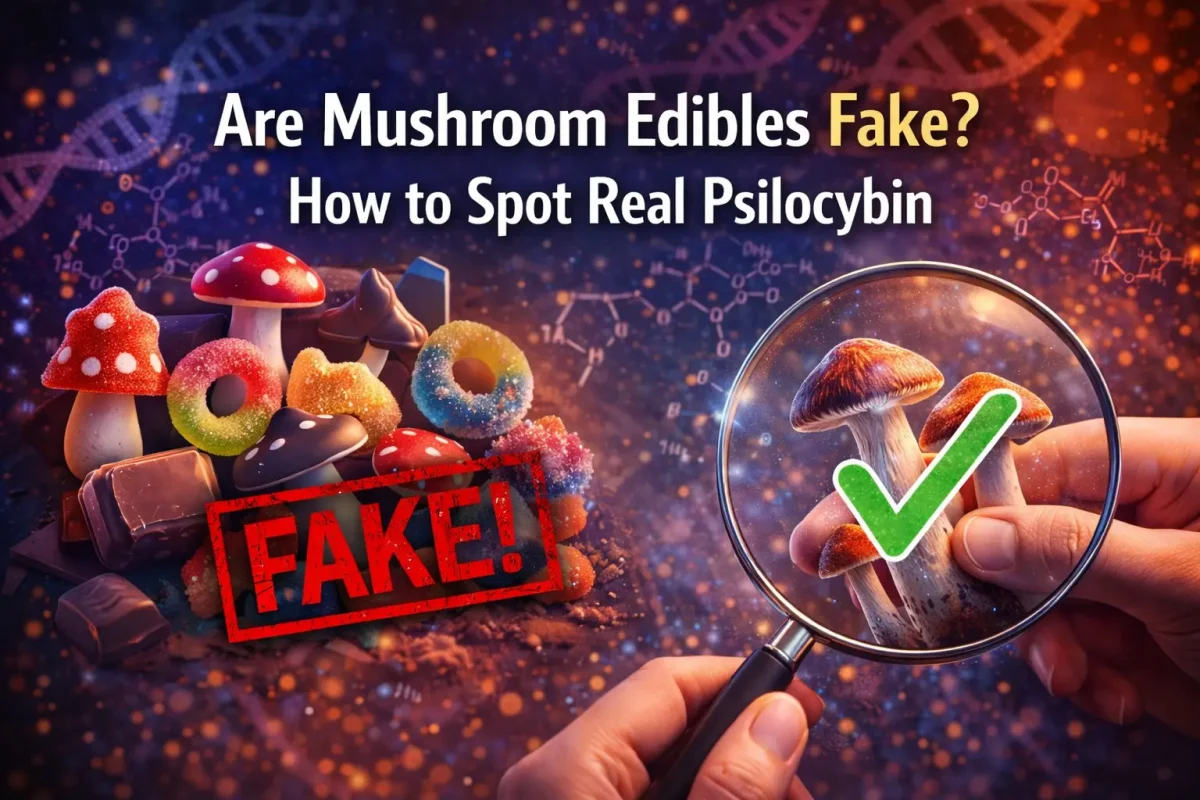
Are mushroom edibles fake? If you’re buying them from a smoke shop, gas station, or convenience store, the answer — according to peer-reviewed science published in the Journal of the American Medical Association — is almost certainly yes. A 2025 study led by Oregon State University researchers purchased 12 gummies and chocolates labeled as magic mushroom edibles from Portland retail stores and analyzed their contents using advanced laboratory methods. The result was alarming: not a single product contained psilocybin. Not one.
What they did find is even more concerning — undisclosed synthetic compounds, caffeine, hemp, kava, and in several cases, experimental synthetic psychedelics whose safety has never been tested in humans. The fake mushroom edible problem is not a fringe issue or a cautionary rumor. It is a documented, peer-reviewed public health crisis that put 180 people in emergency rooms across 34 US states in 2024 alone, resulting in 73 hospitalizations and three deaths.
If you’re researching mushroom edibles, understanding this landscape is non-negotiable. This guide tells you everything you need to know — what fake mushroom edibles actually contain, why they’re dangerous, how to spot them, and what genuine lab-tested products look like. For context on what real psilocybin actually is and how it affects your brain, see our complete guide to psilocybin mushroom strains.
The Landmark Study: What OSU Actually Found
In September 2025, researchers from Oregon State University’s College of Pharmacy published their findings in JAMA Network Open — one of the most respected medical journals in the world. The study was a collaboration between OSU, Rose City Laboratories (a state-certified Portland testing lab), and Shimadzu Scientific Instruments.
The team purchased 12 retail products — 11 gummies and one chocolate — all marketed as magic mushroom edibles. They then subjected each product to advanced chromatography and mass spectrometry analysis.
The results:
- Zero products contained psilocybin — including one product whose label explicitly stated “psilocybin 100mg per gummy”
- Zero products contained muscimol — the psychoactive compound in Amanita mushrooms, even when listed on labels
- 7 of 12 products contained at least one undisclosed active ingredient
- 3 products contained synthetic psilocin — likely laboratory-manufactured rather than naturally derived
- 2 products contained “syndelics” — entirely synthetic psychedelic compounds called mipracetin and 4-hydroxy-diethyltryptamine, whose effects on humans have never been formally studied
- Other adulterants found: cannabinoids (cannabis extract), kavalactones (kava), and high levels of caffeine
🔗 Authority Source: Active Constituents of Psilocybin Mushroom Edibles — JAMA Network Open, Sept 2025
The study’s lead researcher, Professor Richard van Breemen of OSU’s Linus Pauling Institute, described the fake mushroom edibles situation as a significant public health risk: products are being mislabeled and sold to consumers who believe they’re getting a known substance with a documented safety profile, but are instead consuming experimental compounds with completely unknown pharmacology and toxicity.
What Are “Syndelics” — and Why Are They Dangerous?
The most alarming finding in the OSU study was the presence of what researchers named “syndelics” — synthetic psychedelics engineered in illegal laboratories to mimic the structure of psilocybin and LSD.
The two syndelics identified — mipracetin and 4-hydroxy-diethyltryptamine — have a chemical structure similar to psilocybin and psilocin and are psychoactive. Their effects on the human body have never been studied in any formal clinical trial. Nobody knows what dose is safe. Nobody knows how they interact with medications. Nobody knows their long-term toxicity profile.
As van Breemen explained, while the concept of synthesizing psychedelic analogs has legitimate research potential for discovering new medicines, any new drug entity requires years of development to evaluate human safety and efficacy. Premature exposure to these compounds poses significant public health risks due to their completely unknown pharmacology and toxicity.
In plain terms: if you consume fake mushroom edibles containing syndelics, you are ingesting compounds that have never been tested in a human being. That is categorically different from the risk profile of psilocybin, which has been studied in hundreds of controlled clinical trials with a well-documented safety profile. Understanding the real safety framework for genuine psilocybin experiences — including proper preparation and harm reduction — is covered in depth in our Ultimate Harm Reduction Guide.
Why Are Fake Mushroom Edibles Everywhere?
Understanding why fake mushroom edibles flood the retail market requires understanding the legal patchwork that created the opportunity.
Psilocybin is legal for supervised therapeutic use in Oregon and Colorado, and has been decriminalized in a growing number of US cities. But this has created a grey market of products that exploit consumer confusion — products packaged with psychedelic imagery, mushroom branding, and claims of “natural” or “functional” ingredients that are legally ambiguous but misleading.
Fake mushroom edibles are typically sold by businesses that cannot legally sell actual psilocybin, so they substitute cheaper, unregulated synthetic compounds that produce some psychoactive effect — while labeling the product with mushroom imagery and language to capture the demand from buyers seeking psilocybin.
The result is a marketplace where:
- The label says “magic mushroom” but the product contains no mushroom compounds of any kind
- The “effects” come from undisclosed synthetic chemicals with zero safety data
- Packaging is deliberately designed to look like regulated, legitimate psychedelic products
- Consumers have no way to know what they’re actually consuming
This is not a minor mislabeling issue. It is systematic fraud with documented health consequences. The CDC reported 180 emergency cases related to magic mushroom products in 2024 across 34 states.
🔗 Authority Source: CDC Emergency Cases — Magic Mushroom Products 2024, cited in OSU/MedicalXpress Report
7 Red Flags That Tell You Mushroom Edibles Are Fake
Learning to identify fake mushroom edibles requires knowing what genuine lab-tested products look like — and what unregulated products use to imitate them. Here are the seven biggest warning signs that you’re looking at a fake mushroom edible product:
🚩 Red Flag 1: Sold at a smoke shop, gas station, or convenience store Genuine psilocybin products are regulated in Oregon and Colorado and dispensed through licensed channels. Any are mushroom edibles fake question can largely be answered by where you found them — if it’s a general retail environment, assume synthetic adulterants.
🚩 Red Flag 2: No Certificate of Analysis (COA) available Legitimate products come with a third-party lab test — called a Certificate of Analysis — that documents exactly what compounds are present and in what quantities. If a company cannot produce a COA on request, that is a definitive red flag.
🚩 Red Flag 3: Psychedelic imagery without specific compound disclosure Products that use mushroom graphics, trippy patterns, and vague “natural” claims without disclosing the specific psychoactive compound (psilocybin, psilocin, or muscimol) and its exact mg dose should be treated as suspect.
🚩 Red Flag 4: “Amanita muscaria” labeling with no verified muscimol content Some products use Amanita muscaria mushroom extract as a legal alternative to psilocybin. While muscimol (the active compound in Amanita mushrooms) is itself legal in most US states, the OSU study found products labeled as containing Amanita compounds that contained none at all.
🚩 Red Flag 5: Unusually low price Authentic lab-tested psilocybin products require genuine mushroom cultivation, proper extraction, precise dosing, and third-party lab verification. Extremely cheap products cannot afford these processes — which means they’re substituting with something cheaper.
🚩 Red Flag 6: No manufacturer information or contact details Legitimate companies stand behind their products with transparent business information. Anonymous or untraceable brands are a warning sign.
🚩 Red Flag 7: Claims that seem too good to be true “100mg psilocybin per gummy” sold in a gas station for $8? That is not how regulated, lab-verified psilocybin products work.
What Genuine Lab-Tested Psilocybin Products Look Like
Authentic mushroom edibles from reputable sources have clearly distinguishable characteristics from fake mushroom edibles. Here’s what to look for:
✅ Certificate of Analysis (COA): A third-party lab report — from an accredited independent laboratory — that confirms the presence and quantity of the stated compound (psilocybin, psilocin, or muscimol) and screens for the absence of harmful adulterants. The COA should include the lab’s name, accreditation details, and test date.
✅ Strain-specific information: Genuine psilocybin products identify the mushroom strain used, because different strains have significantly different potency profiles. If a product claims to be psilocybin-based but doesn’t specify the strain, that’s a gap. Our Psilocybin Mushroom Strain Encyclopedia explains why strain identity matters for consistent, predictable dosing.
✅ Precise, consistent dosing: Lab-tested products specify the exact dose per unit in milligrams and can demonstrate consistency across batches through repeated COA documentation.
✅ Transparent company information: Legitimate brands have verifiable business information, customer service contacts, and a traceable history.
✅ Compliance with applicable state laws: In Oregon and Colorado, legitimate psilocybin products are produced by licensed cultivators and dispensed through regulated channels. In states without legal psilocybin frameworks, authentic products come from verifiable, transparent sources with documented testing.
Why This Matters Beyond Individual Safety
The fake mushroom edible problem has implications that extend beyond individual consumer safety — it has the potential to poison the well for the entire psychedelic medicine movement.
Every emergency room visit caused by a mislabeled synthetic compound is reported in media as a “magic mushroom” emergency. Every adverse event linked to an unregulated syndelic product becomes ammunition for those opposing the therapeutic use of genuine psilocybin. The fraud being committed by unregulated fake mushroom edible sellers actively undermines the legitimate clinical research that could make psilocybin-assisted therapy available to millions of people suffering from depression, PTSD, and addiction.
Supporting transparent, lab-tested products is not just a personal safety decision — it’s an act of advocacy for the integrity of psychedelic medicine. For more on how psychedelic therapy is developing and what’s at stake, see our Psychedelic Therapy in 2026 guide. And if you’re new to microdosing specifically, our 30-Day Microdosing Beginner Plan covers how to approach the practice safely with verified products.
Frequently Asked Questions (FAQ)
Q: Are all mushroom edibles sold online fake? Not all, but the risk is very high. The OSU study specifically found that fake mushroom edibles are sold widely online as well as in physical retail locations. Only purchase from sources that provide full third-party Certificate of Analysis documentation and can clearly verify the presence and quantity of the stated compound.
Q: Are mushroom edibles fake if they use Amanita muscaria? Amanita muscaria products contain muscimol rather than psilocybin and are legal in most US states. However, the OSU study found products labeled as containing Amanita compounds that contained none at all — so even Amanita-labeled products should have verified COA documentation before you trust them.
Q: What should I do if I think I’ve consumed fake mushroom edibles? If you are experiencing unexpected or alarming effects after consuming mushroom edibles, contact Poison Control (1-800-222-1222 in the US) or seek emergency medical care. Be honest with medical staff about what you consumed — they cannot treat you effectively without accurate information.
Q: How can I verify a Certificate of Analysis is real? A genuine COA names the third-party testing laboratory, includes the lab’s accreditation credentials, provides a test date and batch number, and can typically be verified by contacting the lab directly. Fake COAs exist — if anything feels off, contact the named lab directly to confirm the results are on file.
Q: Are The Shroom Sage products lab-tested? Yes. Every Shroom Sage product comes with third-party lab verification confirming compound identity, potency, and the absence of adulterants. This is the baseline standard we hold ourselves to — and the standard every mushroom edible brand should be held to.
⚠️ Disclaimer: This article is for educational and consumer safety purposes only. Psilocybin remains a federally controlled substance in the United States. Always verify the legal status of psychedelic compounds in your jurisdiction before purchasing or consuming any mushroom edible product.
→ Read Next on The Shroom Sage:
- How Long Do Psilocybin Edibles Last? Duration Guide
- The Ultimate Harm Reduction Guide for Psychedelic Mushroom Trips
- Psilocybin Legality by State in 2026: The Complete Updated Map
- How to Start Microdosing: A 30-Day Beginner Plan
