

Product Guides, Psilocybin Mushrooms
Liberty Cap Mushrooms: Identification, Effects & Where to Buy
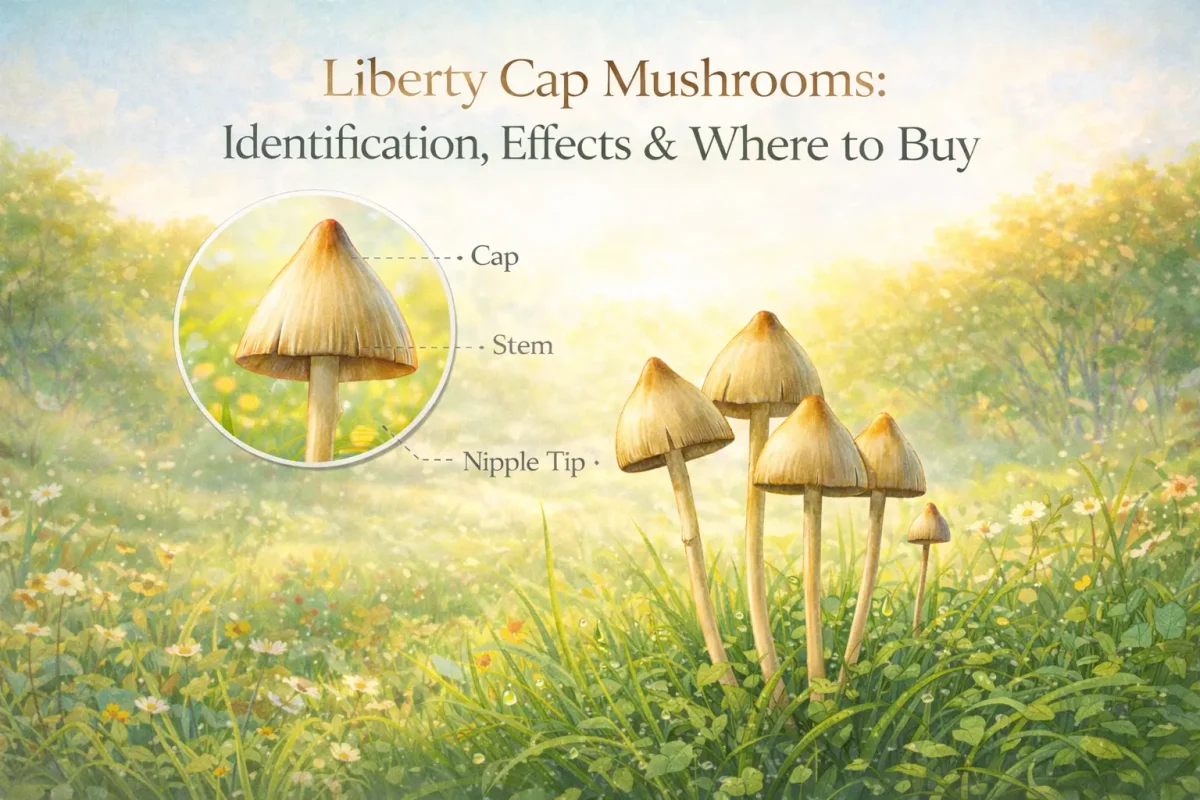
Liberty caps (Psilocybe semilanceata) hold a special place in psychedelic history and culture. As one of the most potent naturally occurring psilocybin mushrooms and one of the most widespread species in the world, these small, unassuming fungi have been introducing humans to altered states of consciousness for thousands of years.
Unlike cultivated strains like Golden Teacher or Penis Envy, Liberty caps grow wild in pastures and grasslands across much of the Northern Hemisphere. Their seasonal appearance, distinctive features, and powerful effects make them a sought-after species—but also one that requires knowledge and caution to identify and use safely.
This comprehensive guide covers everything you need to know about Liberty caps: how to identify them correctly, what to expect from the experience, their potency compared to other strains, and where you can source them legally and safely.
What Are Liberty Caps?
Scientific Classification
Scientific name: Psilocybe semilanceata
Common names: Liberty cap, witch’s hat, blue leg
Family: Hymenogastraceae
Genus: Psilocybe
Active compounds: Psilocybin, psilocin, baeocystin
Historical and Cultural Significance
Liberty caps have a rich history spanning continents and centuries:
Archaeological evidence:
- Possible depiction in ancient cave art (9,000+ years old)
- Used by indigenous peoples in Central and South America
- Evidence of use in prehistoric Europe
Modern rediscovery:
- First scientifically described in 1838 by Swedish mycologist Elias Magnus Fries
- Psilocybin content confirmed in 1960s
- Became prominent in 1970s-80s psychedelic culture
- Featured in numerous trip reports and mushroom guides
Cultural impact:
- Inspired art, music, and literature
- Central to UK rave and festival culture
- Subject of mycological research
- Important in history of psychedelic therapy
The name “Liberty cap”: Refers to the Phrygian cap (also called Liberty cap) worn as a symbol of freedom in ancient Rome and later adopted during the American and French Revolutions. The mushroom’s distinctive pointed cap resembles this historical symbol.
Physical Identification Guide
Liberty caps have distinctive features, but proper identification requires attention to multiple characteristics. Warning: Misidentification can be dangerous. Several toxic mushrooms grow in similar environments.
Cap (Pileus) Characteristics
Shape:
- Young: Conical with distinctly pointed nipple (umbo)
- Mature: Bell-shaped or convex
- Key feature: Pronounced nipple-like point at top (even when expanded)
- 5-25mm diameter (0.2-1 inch)
- Margin has fine grooves (striations) when moist
Color:
- Wet: Olive-brown to yellow-brown
- Dry: Pale buff to cream colored
- Hygrophanous: Color changes dramatically as it dries
- Often has darker, olive-green tones in center
- May have slight bluish tinge (indicates psilocin oxidation)
Texture:
- Smooth, slightly sticky when wet
- Gelatinous pellicle (thin skin) can be peeled away
- Becomes matte when dry
Stem (Stipe) Characteristics
Size and shape:
- 40-100mm tall (1.5-4 inches)
- 1-3mm thick
- Slender and wavy/undulating
- Often curves rather than grows straight
- No ring (annulus) on stem
Color:
- Cream to pale yellow-brown
- Base may have white mycelium
- Bruises blue/blue-green when handled (psilocin oxidation)
- Blue staining is a key positive identification marker
Texture:
- Smooth, silky appearance
- Fibrous and tough (doesn’t snap cleanly like some toxic species)
- Slightly flexible
Gills (Lamellae)
Attachment: Adnexed to adnate (barely touching or slightly attached to stem)
Color when young: Pale gray to cream
Color when mature: Dark purple-brown to blackish
Spacing: Close together
Edge: Lighter colored than faces
Spore Print
Color: Dark purple-brown to blackish-purple
How to make a spore print:
- Remove cap from stem
- Place gill-side down on white paper
- Cover with glass or bowl
- Wait 4-12 hours
- Check color of deposited spores
Why it matters: Spore print color is crucial for identification. Several look-alike species have different colored spores.
Smell and Taste
Smell:
- Mild, slightly earthy
- Some describe as “radish-like”
- Not unpleasant or strongly distinctive
Taste (if tasting for ID—not recommended for beginners):
- Mild, not distinctive
- Slightly farinaceous (flour-like)
- Never taste unless you’re experienced at mushroom ID
Where and When Liberty Caps Grow
Geographic Distribution
Liberty caps are one of the most widely distributed psilocybin species:
Northern Hemisphere:
- United Kingdom and Ireland: Extremely common
- Northern Europe: Netherlands, Germany, Scandinavia
- North America: Pacific Northwest, northeastern US, Canada
- Asia: Parts of Russia, Japan
Southern Hemisphere:
- Less common but present in:
- Chile
- Australia (Tasmania)
- New Zealand
Climate requirements:
- Cool, temperate climates
- High moisture/rainfall
- Rarely found in hot or arid regions
Habitat and Growing Conditions
Preferred environments:
Grasslands and pastures:
- Sheep and cattle pastures (most common)
- Well-grazed, short grass
- Nutrient-rich soil from animal manure
- Not directly on dung (unlike some Psilocybe species)
Other locations:
- Lawns and playing fields
- Golf courses
- Parklands
- Meadows and heaths
- Coastal dunes with grass
They do NOT grow:
- In forests or woods
- Directly on dung
- On cultivated grain fields
- In urban areas without grass
Soil and substrate:
- Acidic to neutral soil (pH 5-7)
- Rich in organic matter
- Well-draining
- Sandy or loamy texture
Seasonal Availability
Northern Hemisphere:
Peak season: September through November (autumn/fall)
Conditions:
- After first frosts
- When temperatures drop to 50-65°F (10-18°C)
- Needs consistent rainfall
- Morning dew important
Extended season:
- Can fruit late August in northern regions
- May continue into December in mild years
- Prolonged warm autumns extend season
Southern Hemisphere:
- April through June (their autumn)
- Same temperature and moisture requirements
Daily timing:
- Best found early morning (more visible when wet)
- Caps dry and become less distinctive by afternoon
- Check within 24-48 hours of rain
Look-Alike Species (CRITICAL SAFETY INFO)
This is essential knowledge. Several species can be confused with Liberty caps, some of which are poisonous.
1. Protostropharia semiglobata (Dung Roundhead)
Similarities:
- Grows in same habitats
- Similar color range
- Similar size
Key differences: ✓ Grows directly on or near dung (Liberty caps don’t)
✓ No nipple on cap (rounded, not pointed)
✓ Has a ring on stem (Liberty caps lack this)
✓ Doesn’t bruise blue
✓ Yellow-brown spore print (not purple-brown)
Toxicity: Not dangerously poisonous but can cause gastric distress
2. Panaeolus species (Mottlegills)
Similarities:
- Dark spores
- Grassland habitat
- Some bruise blue
Key differences: ✓ Caps are more rounded/convex
✓ Lack the distinctive pointed nipple
✓ Gills are mottled (unevenly colored)
✓ Spores are true black (not purple-brown)
Toxicity: Variable—some are edible, some cause illness. Not deadly but unpleasant.
3. Conocybe species (Dunce Caps)
Similarities:
- Conical caps
- Grassland habitat
- Similar size and color
Key differences: ✓ No nipple on cap
✓ Stem snaps cleanly (Liberty caps are fibrous)
✓ Brown spore print (not purple)
✓ Never bruises blue
✓ Gills don’t darken as dramatically
Toxicity: Some species contain deadly amatoxins. NEVER consume Conocybe species.
4. Young Psilocybe cyanescens
Similarities:
- Bruises blue
- Contains psilocybin
- Can grow in grassy areas
Key differences: ✓ Wavy cap edge (hence nickname “wavy cap”)
✓ Larger (25-45mm caps)
✓ Prefers wood chips and mulch
✓ Caramel colored when wet
Toxicity: Not toxic—actually contains psilocybin—but much more potent than Liberty caps
Safety Rules for Foraging
NEVER consume a mushroom unless:
- You’re 100% certain of the identification
- You’ve checked multiple identification features
- You’ve made a spore print
- You’ve consulted with an experienced forager
- When in doubt, throw it out
Best practices:
- Carry a good field guide
- Join local mycology groups
- Learn from experienced foragers
- Take clear photos from multiple angles
- Never rely on a single identification feature
Potency and Active Compounds
Psilocybin and Psilocin Content
Liberty caps are among the most potent psilocybin mushrooms:
Average alkaloid content:
- Psilocybin: 0.98% of dry weight
- Psilocin: 0.02-0.36% of dry weight
- Baeocystin: 0.01-0.15% of dry weight
Comparison to other species:
| Species | Psilocybin | Potency Rank |
|---|---|---|
| Liberty Cap | 0.98% | Very High |
| Golden Teacher | 0.63% | Moderate |
| Penis Envy | 1.2-1.8% | Highest |
| Psilocybe cubensis (avg) | 0.63% | Moderate |
| Psilocybe azurescens | 1.78% | Highest |
What this means: Liberty caps are approximately 50-70% more potent than average Psilocybe cubensis strains like Golden Teacher.
Potency Variables
Factors affecting potency:
Growing conditions:
- Cooler temperatures = higher potency
- Moisture levels affect alkaloid production
- Soil nutrients influence strength
- Late season fruiting bodies may be more potent
Individual mushroom variation:
- Caps generally contain more psilocybin than stems
- Larger specimens aren’t necessarily more potent
- Different patches can vary 20-40% in potency
Preservation and storage:
- Properly dried Liberty caps maintain potency 6-12 months
- Improper storage (heat, light, moisture) degrades psilocybin
- Frozen Liberty caps can last 12-24 months
Dosing Considerations
Because Liberty caps are more potent than cultivated P. cubensis, doses must be adjusted:
Dried Liberty Cap doses:
Microdose: 0.1-0.3g (similar to regular mushrooms)
Threshold: 0.5-1g
Light trip: 1-1.5g
Moderate trip: 1.5-2.5g
Strong trip: 2.5-3.5g
Heroic dose: 4g+
Compare to Golden Teacher:
- 2g Liberty caps ≈ 3-3.5g Golden Teacher
- 3g Liberty caps ≈ 5-5.5g Golden Teacher
Important: Start with lower doses until you know how you respond to this particular species.
Effects and Experience Profile
Subjective Experience
Liberty caps produce a classic psilocybin experience with some unique characteristics:
Come-up (30-60 minutes):
- Tingling body sensations
- Slight nausea or stomach discomfort
- First visual distortions (breathing, morphing)
- Sense of anticipation or excitement
- Yawning and stretching common
Peak (2-4 hours):
- Strong visual hallucinations (geometric patterns, enhanced colors)
- Emotional amplification and openness
- Philosophical/spiritual thinking
- Time distortion
- Sense of connection to nature
- Euphoria and well-being
Plateau (4-5 hours):
- Effects continue but stabilize
- Deep introspection
- Heightened appreciation for music and art
- Ability to think more clearly returns
- Physical energy may increase
Come-down (5-7 hours):
- Gentle return to baseline
- Residual visual effects (tracers, breathing)
- Afterglow of positive mood
- Mental clarity and openness
- Body feels relaxed
Afterglow (1-3 days):
- Lasting positive mood
- Increased mindfulness
- Enhanced appreciation for life
- Creative insights continue
- Integration period begins
Liberty Cap-Specific Qualities
Users report certain characteristics seem more pronounced with Liberty caps:
Nature connection: Perhaps because they’re wild mushrooms found in natural settings, many report feeling especially connected to nature and the Earth during Liberty cap experiences.
Clean headspace: Compared to some cultivated strains, Liberty caps often produce clear, lucid thinking without mental fog or confusion.
Body energy: Some users report more physical energy and desire to walk or explore, rather than lying down.
Visual clarity: Visuals described as sharp, crisp, and detailed rather than overwhelming or chaotic.
Emotional gentleness: Despite potency, the emotional content is often described as warm and loving rather than challenging.
Harvesting and Preparation
Ethical and Legal Foraging
Before you forage:
Legal considerations:
- In many places, picking psilocybin mushrooms is illegal
- Foraging on private property without permission is trespassing
- Some nature reserves prohibit all mushroom collection
- Know and follow your local laws
Environmental ethics:
- Take only what you’ll use
- Leave some mushrooms to spread spores
- Don’t damage the mycelium
- Respect the landowner and ecosystem
- Use a knife to cut, don’t pull from ground
Practical considerations:
- Get landowner permission if on private property
- Bring proper identification guides
- Have a way to transport them safely
- Forage sober and with clear judgment
Harvesting Technique
Best practices:
- Positive identification first – Never pick without 100% certainty
- Use a knife – Cut stems rather than pulling entire mushroom
- Leave small or immature specimens – Let them grow and spread spores
- Collect in a basket or paper bag – Allows spores to drop as you walk
- Note location – Return to productive patches in future seasons
- Take photos – Document your finds for later identification verification
Drying and Preservation
Fresh Liberty caps contain ~90% water. Proper drying is essential for preservation.
Drying methods:
Air drying (basic):
- Spread on paper towels or drying rack
- Place in warm, dry location with air circulation
- Use a fan to increase airflow
- Turn occasionally
- Dry until cracker-crisp (3-7 days)
Food dehydrator (recommended):
- Set to 95-115°F (35-46°C)
- Arrange in single layer
- Dry for 4-8 hours
- Check for complete dryness (should snap easily)
Desiccant drying (advanced):
- Pre-dry using fan or dehydrator
- Place in container with food-grade desiccant
- Seal container
- Wait 24-48 hours
- Ensures all moisture removed
Storage:
- Container: Airtight glass jar
- Location: Cool, dark, dry place
- Desiccant: Include silica gel packet
- Duration: 6-12 months potency maintained
- Freezing: Can extend to 12-24 months
Where to Buy Liberty Caps
The Foraging Route
Advantages:
- Free (except your time)
- Connection to nature
- Traditional approach
- Learn mycology skills
- Sustainable if done ethically
Disadvantages:
- Requires knowledge and skill
- Seasonal availability only
- Time and effort intensive
- Legal and safety risks
- No guaranteed finds
- Variable potency
Resources for learning:
- Join local mycology clubs
- Take mushroom identification courses
- Use apps like iNaturalist (for general ID, not consumption)
- Read field guides (see recommendations below)
- Connect with experienced foragers
Purchasing Dried Liberty Caps
Due to legal restrictions in most jurisdictions, we cannot directly link to Liberty cap purchases. However, here’s what to know:
If you’re in a jurisdiction where it’s legal:
Quality indicators:
- Dried to cracker-crisp consistency
- Retain distinctive pointed cap shape
- Some blue staining visible
- No mold or off smells
- Properly packaged
Pricing (where legal):
- Typically $120-200 per ounce
- More expensive than cultivated varieties
- Premium pricing due to wild harvesting
- Seasonal availability affects price
Trusted sources:
- Established vendors with good reviews
- Third-party testing when available
- Clear photos of actual product
- Transparent about sourcing
Alternative: Cultivated Strains
Since Liberty caps cannot be cultivated (they require specific natural conditions), consider these alternatives:
Similar potency:
- Penis Envy Mushrooms – Highest potency cultivated strain
- Psilocybe azurescens – Wild but more cultivatable
Similar character:
- Golden Teacher – Classic, clean experience
- B+ – Gentle, nature-connected feel
Available formats:
- Dried mushrooms – Closest to wild Liberty cap experience
- Capsules – Precise dosing
- Chocolates – Easier consumption
Identification Resources
Recommended Field Guides
Essential books:
- “Psilocybin Mushrooms of the World” by Paul Stamets
- Comprehensive species guide
- Detailed Liberty cap section
- Color photographs
- Growing information
- “The Mushroom Cultivator” by Paul Stamets & J.S. Chilton
- Technical mycology
- Identification keys
- Scientific approach
- “Magic Mushrooms Around the World” by Jochen Gartz
- Geographic distribution
- Chemistry and potency
- Cultural context
Online Resources
Websites and communities:
Shroomery.org
- Identification forum
- Expert community
- Photo archives
- Growing guides
iNaturalist.org
- Mushroom observation database
- Photo verification by experts
- Not for consumption decisions
Reddit communities:
- r/ShroomID (identification help)
- r/shrooms (general discussion)
- r/PsilocybinMushrooms (focused community)
Safety warning: Never rely solely on internet identification. Always verify multiple sources and err on the side of caution.
Liberty Caps vs. Cultivated Mushrooms
Advantages of Liberty Caps
✓ Extremely potent – More bang for your buck
✓ Free if you forage – No purchase necessary
✓ Natural and traditional – Wild, authentic experience
✓ Clean effects – Many prefer the experience quality
✓ Connection to nature – Foraging is part of the journey
✓ No cultivation needed – Nature does the work
Disadvantages of Liberty Caps
✗ Seasonal only – Limited availability
✗ Requires identification skill – Risk of mistakes
✗ Variable potency – Less consistent dosing
✗ Time intensive – Foraging takes effort
✗ Legal risks – Possession illegal in many places
✗ Cannot be cultivated – Can’t grow at home
Advantages of Cultivated Strains
✓ Year-round availability – Always in stock
✓ Consistent potency – Know what you’re getting
✓ No identification needed – Safe and verified
✓ Convenient – Delivered to your door
✓ Lab tested options – Quality assured
✓ Various formats – Capsules, chocolates, etc.
Disadvantages of Cultivated Strains
✗ Cost money – Not free like foraging
✗ Less potent – Most strains weaker than Liberty caps
✗ Less traditional – Modern cultivation
✗ Environmental impact – Indoor growing uses resources
Safety and Harm Reduction
Pre-Trip Preparation
Physical preparation:
- Empty or light stomach (reduces nausea)
- Well-rested and hydrated
- No alcohol or other drugs
- Comfortable clothing
- Clear schedule (no obligations)
Mental preparation:
- Set clear intentions
- Accept whatever arises
- Not in acute mental health crisis
- Positive or neutral mindset
- Prepared for intensity (Liberty caps are potent!)
Environmental preparation:
- Safe, comfortable setting
- Trusted trip sitter if inexperienced
- Nature access if possible
- Music and comfort items
- No responsibilities or interruptions
During the Experience
If anxiety arises:
- Remember: this is temporary
- Change your environment
- Focus on breathing
- Talk to your trip sitter
- Surrender rather than fight
Physical comfort:
- Stay hydrated
- Have light snacks available
- Bathroom access
- Temperature control
- Comfortable seating/lying options
Integration and Aftercare
Immediately after:
- Journal the experience
- Discuss with trusted friend
- Rest and recover
- Gentle re-entry to normal life
Days and weeks following:
- Reflect on insights
- Consider therapy or integration circle
- Make positive changes based on realizations
- Give yourself processing time
Frequently Asked Questions
Are Liberty caps stronger than other magic mushrooms?
Yes, Liberty caps (Psilocybe semilanceata) are significantly more potent than most cultivated strains. They contain approximately 0.98% psilocybin compared to 0.63% in average P. cubensis strains. Adjust your doses accordingly—2g of Liberty caps can equal 3-3.5g of Golden Teacher.
Can you cultivate Liberty caps at home?
No. Liberty caps have a complex symbiotic relationship with grass roots that cannot be replicated in artificial growing conditions. They require specific soil bacteria, temperature cycles, and natural conditions. All attempts at cultivation have failed. If you want to grow psilocybin mushrooms at home, choose P. cubensis strains like Golden Teacher.
How do I know if I’ve found real Liberty caps?
Look for: 1) Distinctive nipple (umbo) on cap, 2) Thin, wavy stem that bruises blue, 3) Dark purple-brown spore print, 4) Grows in grasslands (not on dung), 5) Appears in autumn in cool climates. Always make a spore print and verify multiple identification features. When in doubt, don’t consume.
What’s the best way to consume Liberty caps?
Dried: Most common and potent. Eat plain, grind into powder, or make tea.
Tea: Reduces nausea, slightly faster onset, some potency loss.
Lemon tek: Grind dried caps, soak in lemon juice 20 minutes, consume. Faster, more intense.
Capsules: Grind dried caps, fill capsules for precise dosing.
Are Liberty caps legal to pick or possess?
In most countries, Liberty caps contain psilocybin and are therefore controlled substances. Possession, cultivation, and sale are illegal in most jurisdictions. However, some places have decriminalized possession (Oregon, Colorado, parts of Canada). Always research your local laws. Foraging on private property without permission is trespassing regardless of drug laws.
How long do dried Liberty caps last?
When properly dried (cracker-crisp) and stored in an airtight container in a cool, dark, dry place, Liberty caps maintain full potency for 6-12 months. With desiccant packets and excellent storage, they can last 12-18 months. Frozen in vacuum-sealed bags, they can last 18-24 months. Never store partially dried mushrooms—they will mold.
Conclusion: The Enduring Appeal of Liberty Caps
Liberty caps hold a unique place in the world of psilocybin mushrooms. Their wild nature, potent effects, widespread distribution, and historical significance make them special beyond their alkaloid content.
For foragers: They represent a connection to ancient traditions and the natural world. Finding them is part of the journey.
For psychonauts: They offer powerful, clean experiences that many prefer to cultivated alternatives.
For researchers: They’re one of the most studied psilocybin species, contributing to our understanding of these compounds.
Whether you forage or purchase, always prioritize:
- Correct identification (when foraging)
- Safe, clean products (when purchasing)
- Appropriate dosing
- Proper set and setting
- Integration and aftercare
Explore responsibly:
Shop Premium Dried Mushrooms – Alternatives to Liberty caps
Browse Psilocybin Products – Capsules, chocolates, and more
Read Our Safety Guides – Preparation and harm reduction
Questions about Liberty caps? Contact our knowledgeable team.
Disclaimer: This article is for educational purposes only. Liberty caps contain psilocybin, a controlled substance in most jurisdictions. Foraging and possession may be illegal in your area. The Shroom Sage does not encourage illegal activity. Always research local laws, never consume a mushroom without 100% positive identification, and consult healthcare professionals before use.
